
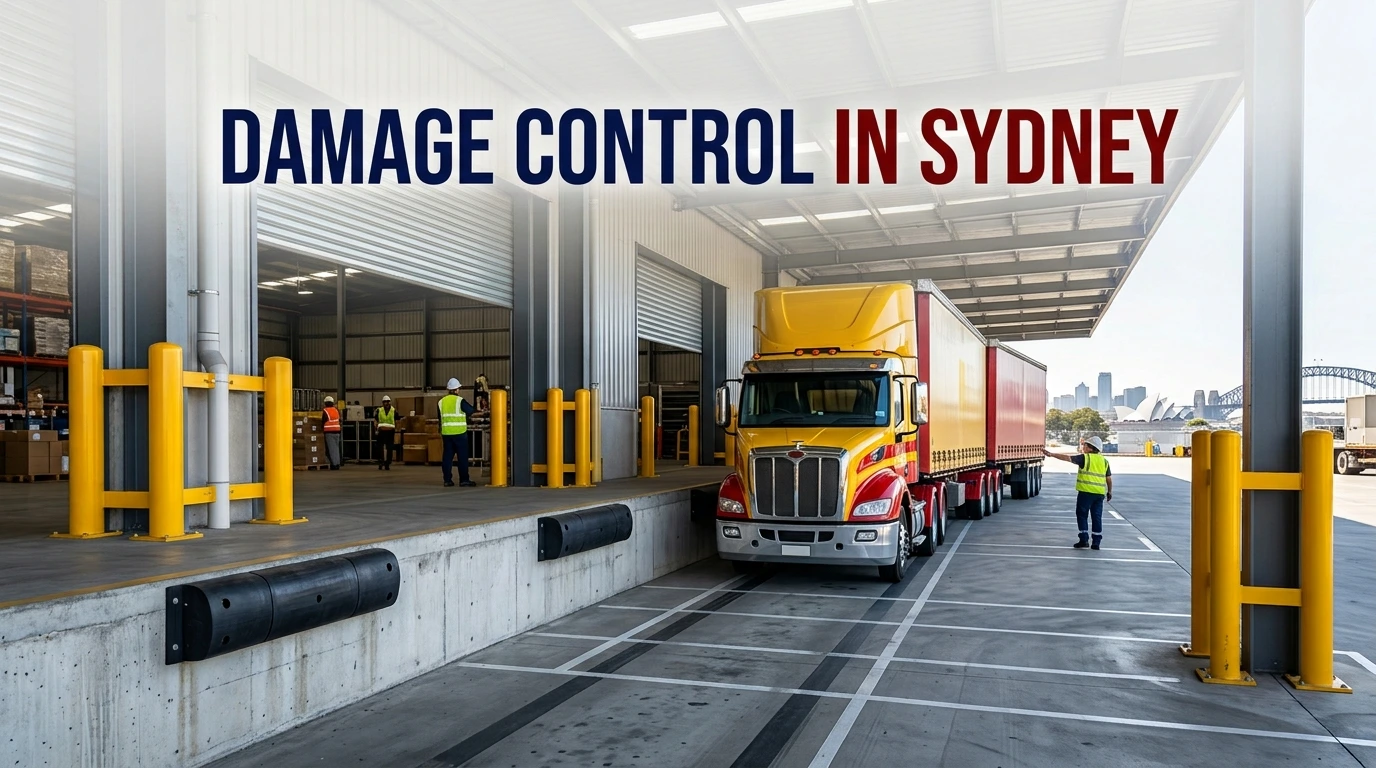
Sydney loading dock with yellow bollards, bumpers, and a reversing semi-truck.

How to Protect Delivery Docks and Loading Bays from Heavy Vehicle Damage in Sydney

If you work in a warehouse, distribution center, or logistics facility anywhere in Western Sydney, then chances are that you are aware of the fact that the loading bay is the busiest area and the one receiving the highest structural impact damage of your property. The reason is simple; semi-trailers, B-doubles and rigid trucks back up into tight bays regularly throughout the day. Often they do so quickly, in less than perfect light, and in conditions when the driver is unfamiliar with your facility.
 
But the consequences extend way beyond a dent in the paintwork. One single mistake while reversing can mean breaking a structural column, tearing off a roller shutter from its tracks, rupturing your pipes and damaging your concrete dock edge. All this leads to loss of productivity, insurance claim costs and in some cases creates a safety risk for the people working in the vicinity of the damaged area. This is why loading dock protection Sydney needs to be taken care of seriously.
 
Uneek Metalcraft specialises in installation of loading docks in industrial facilities of Sydney and here is how our guide helps you understand what makes the difference between loading dock damage and protection.

Why Loading Bays Are Sydney’s Highest-Impact Zones

Contrary to the average parking lot, a loading dock encompasses several hazards all at once: heavy vehicles; constrained angle of reversal; pressure on the driver; and structural elements such as columns, doors, and piping located near the vehicle. Furthermore, many existing industrial estates in Sydney were not initially planned for the contemporary generation of bigger B-double and semi-trailer trucks, and therefore have dock configurations that are less than optimal.
 
Moreover, the weather, dim illumination, and turnover of the driver (especially in case of contracted logistics companies) contribute to an increased chance of reversing into the dock improperly. To be more precise, the last two or three meters of the reversal process, which represents the closest proximity of the trailer to the dock wall, is where almost all of the major impacts occur.
 

The Common Damage Points

Before specifying protection hardware, it helps to understand exactly what gets hit and why. In our experience fitting out Sydney facilities, four damage points come up again and again:

  • Structural columns near the dock face — often struck by trailer corners or forklifts working the bay.

  • Roller shutter door tracks and frames — vulnerable when trailers reverse slightly off-centre.

  • Exposed pipework and conduit — frequently mounted at bumper height with no barrier.

  • Concrete dock edges and ramps — chip, crack, and spall under repeated wheel and trailer contact.

However, not all points of damage pose equal risks. A chip on the edge of concrete pavement is a matter of maintenance while the crushing of a column is one of structure. That is why the accuracy of risk assessment, in pairing damage types to hardware, becomes more important than a universal strategy.

Damage Type Impact Level Recommended Protection Hardware
Trailer/truck corner strikes on columns High — structural risk Heavy-duty steel bollards, heavy corner guards
Roller door track misalignment from impact Medium–High — operational downtime Heavy bollard line + guide rail, corner guards on adjacent frames
Exposed pipework/conduit strikes Medium — safety and compliance risk Pipe guards, bollard barriers, bumper rail
Concrete dock edge spalling and cracking Medium — ongoing repair cost Rubber dock bumpers, edge angle protection
Trailer misalignment against dock face Low–Medium — repeated wear Wheel alignment guides, dock bumpers

Essential Dock Protection Hardware

The next step after mapping the risk points is to specify hardware that actually fits the forces involved. Most of our dock protection is custom fabricated on site to the exact bay dimensions and vehicle types as off-the-shelf generic solutions just don’t hold up to daily heavy vehicle traffic.

Heavy-duty steel bollards remain the backbone of any serious dock protection plan. Positioned at column bases, dock corners, and door frames, they absorb and redirect impact before it reaches structural elements. For guidance on the correct specification and mounting for your site, our guide to Australian standard bollard regulations covers the compliance requirements in detail.

Heavy corner guards protect column edges and wall junctions from glancing impacts, the kind of contact that’s too frequent and too low-speed to justify a full bollard, but still damaging over time. We’ve covered specification and placement in our piece on corner guards and wall protection.

Rubber dock bumpers act as a buffer at the point of contact between the trailer and the face of the dock itself, reducing wear on the edges of concrete and ensuring the trailer doesn’t hit the building structure directly. So they are one of the cheapest additions you can make to any dock upgrade.
 
Wheel alignment guides help drivers to position trailers correctly on final approach, thereby avoiding an off-centre reverse from the outset. They work well as part of a complete system with bumpers and bollards rather than a standalone fix specifically.
 
Beyond the dock face itself, don’t overlook the surrounding warehouse floor — forklifts moving freight to and from the dock cause their own damage pattern, which we address in our guide to warehouse racking and column protection. If your facility utilizes elevated storage or second-tier pick faces, learn how custom steel mezzanine structures expand Sydney industrial warehouse capacity while keeping ground-level transit lanes safe.


In-Ground vs. Surface-Mount for Loading Docks

The most frequent question facility managers pose about bollards concerns installation style – in-ground versus surface mount. And the answer is…it all depends on the impact zone.
 
In-ground bollards are mounted to a concrete footing at ground level and have much greater resistance to lateral impact. Therefore, they are favored in high-risk impact zones such as dock corners, where the trailer frequently strikes, and columns which could suffer significant cost if structural integrity were compromised.
 
Surface-mount bollards mount directly onto concrete and are quicker and easier to install and relocate. They are well suited for low-risk impact zones or areas where ground work cannot be done (such as docks over service conduits). However, surface mount bollards offer less resistance to the impact of a fully loaded trailer than in-ground bollards do.
 

For a full breakdown of load ratings, installation depth, and when each option makes sense, see our detailed comparison of in-ground versus surface-mount bollards, as well as our practical surface mount bollard installation guide if you’re weighing up a DIY-adjacent approach versus a fully engineered install.

It’s also worth noting that dock protection design should align with broader workplace safety obligations. Safe Work Australia guidance on managing risks from vehicles and mobile plant sets out clear expectations around traffic management and hazard control in areas where heavy vehicles and pedestrians interact — loading bays being a prime example. Similarly, Transport for NSW freight and heavy vehicle guidance is a useful reference point when planning access zones and reversing paths for larger vehicle classes.

Getting Your Dock Protection Right the First Time

Loading bay protection is not a product, it is a system: Bollards, corner guards, bumpers and alignment guides all have a job to do. Get the placement and specification wrong and you pay twice for the damage, once in down time and once in the fix.
 
This is where the planning for dock corner and wall protection pays off. Each Sydney site has a different bay geometry, vehicle mix and traffic pattern and that’s why we’re recommending a proper site assessment before any hardware goes in, not a generic package pulled off a shelf.
 
If you’re reviewing your facility’s broader risk exposure, our commercial property safety checklist is a solid starting point for identifying other vulnerable zones beyond the dock itself.

As a leader in custom metal fabrication in Sydney businesses have trusted for years, our experienced fabrication team at Uneek Metalcraft designs and fabricates heavy duty dock bollards, corner guards, and dock protection systems built for the realities of Sydney’s freight traffic, not generic, off-the-shelf specs.

Ready to protect your loading bay? Contact Uneek Metalcraft today to book an on-site dock protection audit. We’ll assess your bay geometry, vehicle traffic, and existing damage points, then provide a tailored hardware plan and quote, so your next reversing truck meets steel, not structure.

Request Your Custom Quote →