
Sep
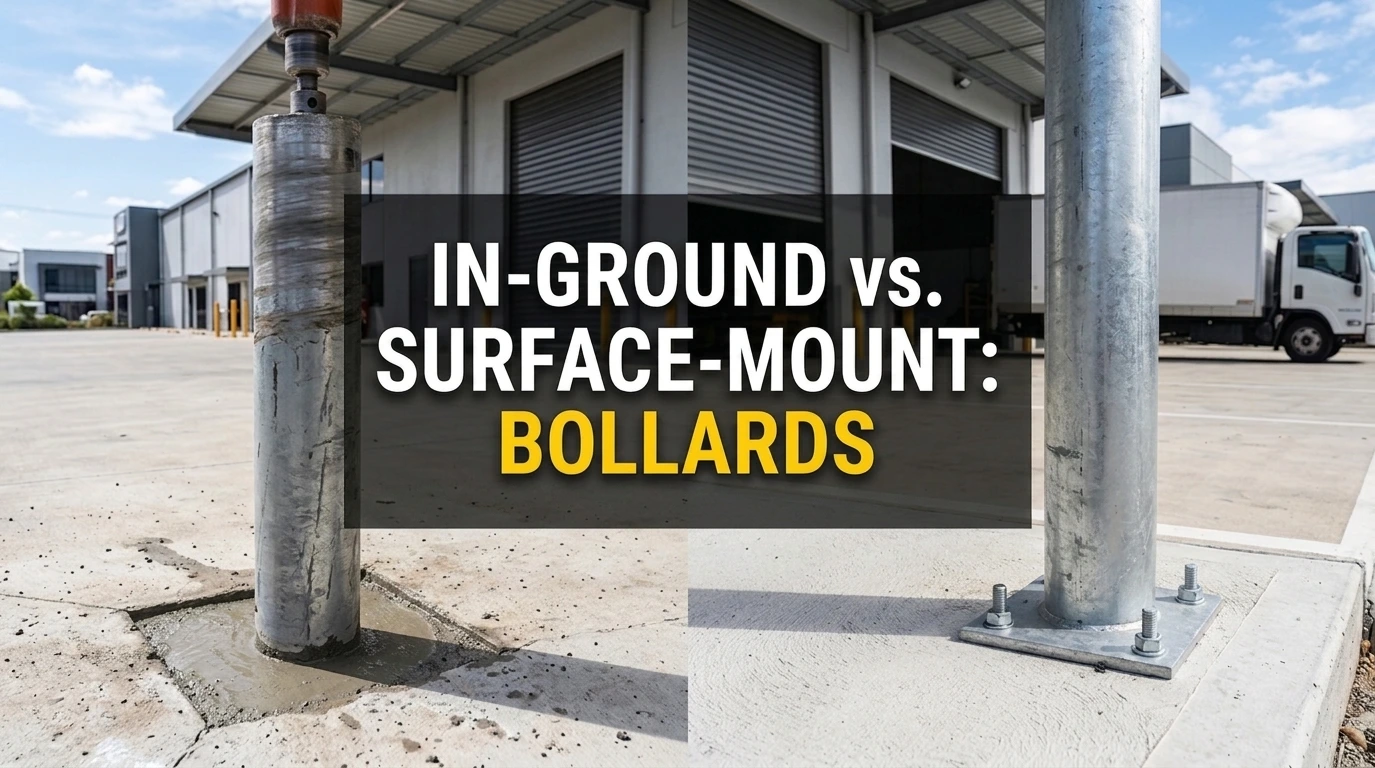
When it comes to making the same structural error over and over again in the design of a facility protection plan, the choice of bollard products prior to analyzing the substrate is made most often by managers at Sydney. The size of the steel, wall thickness, and finishing of the bollard are all important; however, if the bollard mount is inappropriate for the substrate that it rests upon, none of those factors really matter. In particular, in-ground bollards versus surface-mounted bollards is the determining factor of kinetic energy absorption.
This difference distinguishes the creation of an insurance-friendly asset protection system and an expensive steel post that will collapse upon the first hit. Being the experts of commercial asset protection Sydney, this question pops up on almost every consultation visit for everything from the installation of strata-managed car parking to the protection of retail storefronts. Hence, this guide is your best resource when it comes to the engineering and practicality aspects of these two mounting systems.
In-Ground (Core-Drilled/Embedded) Bollards
Inground bollards that provide real protection against impact damage to Sydney premises are those that are placed into the substrate by using core drilling. A core-drilled hole is made in the concrete or asphalt substrate at a certain depth of footing, which ranges from 450mm to 600mm for normal use, but is even greater when considering ram raid protection at a Sydney site. In other words, the bollard is installed within the hole, which is filled with concrete or resin grout, thus fixing the post in the substrate itself.
Why this matters structurally: an in-ground bollard distributes impact force down through its full embedded length, using the surrounding concrete or soil as a lever-resisting mass. On comparison, a surface-mounted post has to transfer the same force through a handful of anchor points at ground level. As a result, core-drilled bollards consistently achieve the highest impact ratings of any fixed bollard type, making them the default specification for:
- Storefronts and pharmacies with documented ram-raid risk
- Loading dock aprons and forklift transit zones
- Council-mandated pedestrian separation zones
- Any application where the substrate is asphalt, soil, or unreinforced paving rather than structural concrete
Because in-ground bollards key into the substrate rather than sitting on it, they’re also the only realistic option on asphalt or compacted soil, a surface-mount base plate has nothing solid to bolt into on those substrates. To ensure compliance with impact-rated specifications, our engineering team calculates footing depth against the expected vehicle mass and speed for each site, rather than defaulting to a generic depth. Furthermore, in-ground bollards suit high-value assets discussed in our preventing forklift damage to warehouse racking and columns guide, where repeated low-speed impacts demand a mounting method that won’t work loose over time.
Surface-Mounted (Base Plate) Bollards
- Suspended and post-tensioned slabs. Multi-storey car parks built on post-tension cable structures cannot be core drilled without risking a cable strike, which is both a safety hazard and a structural integrity issue. Surface mounting with shallow chemical anchors avoids this risk entirely.
- Rapid retrofitting. A retail tenancy that needs perimeter protection installed overnight, or a strata property responding to an immediate risk after an incident, benefits from a same-day surface-mount install with no wet-trade curing delay.
- Leased premises. Tenants without authority to core-drill a landlord’s slab can still achieve a strong level of protection using a bolt-down system.
- Removable or relocatable applications. Base plate bollards can be unbolted and repositioned as a site’s traffic flow changes, which in-ground bollards cannot do without re-coring.
The trade-off is impact capacity. Specifically, a surface-mounted bollard’s resistance is limited by anchor pull-out strength and the thickness and reinforcement of the slab it’s bolted to — a thin, poorly reinforced concrete slab mounting will fail well before a comparable in-ground post would. Our own step-by-step surface mount concrete installation guide covers anchor spacing, torque specifications, and slab-thickness minimums in detail for teams planning a DIY-adjacent install under supervision.
Detailed Comparison: In-Ground vs. Surface-Mount Bollards
| Factor | In-Ground (Core-Drilled) | Surface-Mount (Base Plate) |
|---|---|---|
| Impact Rating | Highest available; full-depth embedment resists high-velocity ram impact | Moderate to high; limited by anchor pull-out strength and slab reinforcement |
| Substrate | Concrete, asphalt, soil, unreinforced paving | Structural concrete slab only (including suspended/post-tension with shallow anchors) |
| Installation Time | Longer; core drilling, footing, and concrete cure time required | Fast; same-day install with mechanical or chemical anchors |
| Maintenance | Minimal; embedded post rarely loosens | Periodic anchor torque checks recommended, particularly in high-impact zones |
| Cost | Higher upfront (drilling, concrete, labour) | Lower upfront; no wet-trade costs |
| Ideal Application | Storefronts, ram-raid risk sites, loading docks, asphalt/soil sites | Suspended slabs, leased premises, rapid retrofits, relocatable barriers |
In conclusion, there is no better choice, as neither one is superior. The decision will have to be made depending on the conditions and the substrate.
Regulatory & Site Compliance
Bollard specification in NSW isn’t purely an engineering decision; it’s a compliance one. AS/NZS 2890.1 compliance governs car park design and vehicle-pedestrian separation, including bollard placement at pedestrian crossings, ramps, and building entries. In comparison, workplace-specific obligations sit with the broader physical-barrier and traffic-management requirements set out by Safe Work Australia, which apply to any site where vehicles and pedestrians share a working area, warehouses, loading docks, and car parks included.
To ensure compliance, facility managers should treat both standards as complementary rather than interchangeable: AS/NZS 2890.1 addresses car park geometry and pedestrian protection, while SafeWork NSW guidance and broader workplace safety obligations address ongoing risk management for vehicle movement across a site’s operating life. Our guide to complete AS/NZS bollard standards walks through council approval processes and the documentation most Sydney developers are asked to produce during certification.
The type of substrate material also has an obvious implication for compliance issues. Post-tension car park decks, for instance, cannot have holes drilled into them unless a structural engineer confirms the position of the cables through calculations, which is exactly why surface mounted base plate bollards are recommended for multi-level buildings despite their relatively low impact rating. Conversely, street level frontages subject to ram raiding in retail areas will always need to satisfy a higher impact rating than can be achieved with base plate bollards, thereby making core drilling the more appropriate specification choice. All strata property safety equipment installations must be conducted after consulting with both the strata body’s insurers and the installers, owing to the fact that impact ratings determine liability insurance.
Cost & Labor Considerations
Final Decision Framework
Use this checklist to narrow down the correct bollard type for your site before requesting quotes:
- What is the substrate? Asphalt or soil → in-ground only. Suspended or post-tension slab → surface-mount only. Structural ground-level concrete → either option is viable.
- What’s the realistic impact risk? Ram-raid exposure, high-speed transit zones, or heavy vehicle traffic → in-ground for maximum impact rating. Low-speed pedestrian and light-vehicle separation → surface-mount is usually sufficient.
- Is the installation permanent or does it need to be reversible? Leased premises or sites with evolving traffic flow → surface-mount. Permanent perimeter or asset protection → in-ground.
- What’s the installation timeline? Urgent retrofit after an incident → surface-mount for same-day protection. Planned development or fit-out → in-ground can be scheduled into the concrete works phase.
- What does your insurer or certifier require? Confirm the impact rating specified in your building’s compliance documentation before committing to a mounting type — this is often the deciding factor, not budget.
Sites with mixed requirements, a ground-level retail frontage attached to a post-tension basement car park, for instance, very often need both mounting types specified across different zones. Our commercial property safety hardware checklist and guide to protecting car park walls, columns, and exposed pipework both cover how to zone a site by risk and substrate rather than applying one bollard specification everywhere. For businesses weighing up the broader financial case for getting this right the first time, our guide on commercial property compliance and asset protection savings sets out the cost of getting it wrong. And if ram-raid exposure is the primary driver of your project, our dedicated guide to storefront ram-raid security bollards goes deeper into impact-rated specification for retail frontages specifically.
Get the Right Bollard Specification, First Time
Choosing between in-ground and surface-mount bollards isn’t a preference call it’s a substrate, compliance, and risk decision that determines whether your asset protection actually holds under impact. As a leading Sydney bollard manufacturer and factory-direct steel bollards Sydney supplier, Uneek Metalcraft designs and installs both mounting types to AS/NZS specification, backed by our team’s hands-on core drilling bollard installation NSW experience across retail, industrial, and strata sites.
Learn more about our Australian-made metal fabrication process and how our Arndell Park facility supports projects across greater Sydney.
Ready to specify the right bollard for your site? Contact our Sydney engineering team to request a custom quote and speak with a safety compliance specialist before your next pour or retrofit.
📞 Call 0430 303 170 ✉️ Email info@uneekmetalcraft.com.au
